

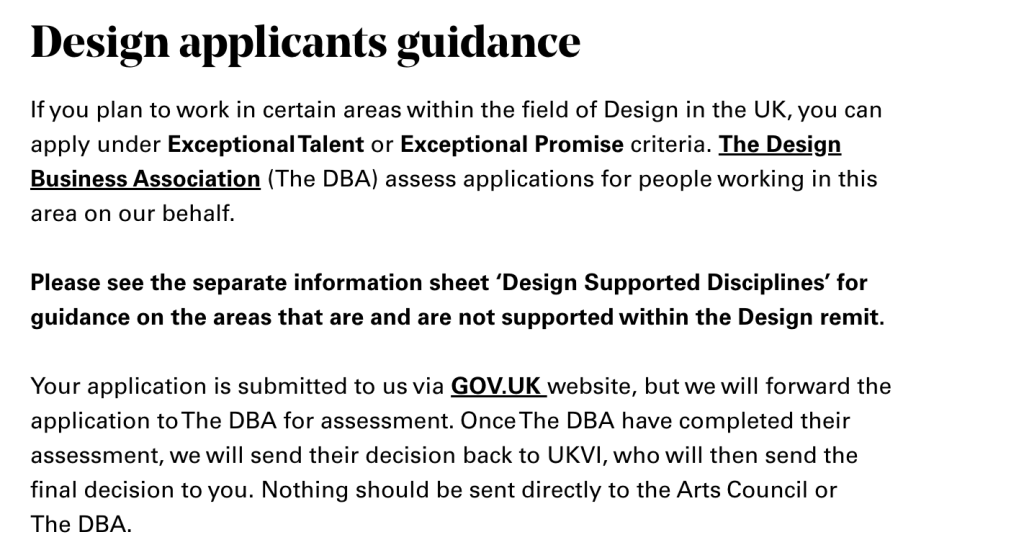
From 1 July 2026, the UK officially introduced a dedicated Design pathway under the Global Talent Visa. Until now, many designers had to apply through related creative disciplines or pursue alternative immigration routes. Designers can now apply through a standalone pathway with its own assessment criteria and a dedicated endorsing body: the Design Business Association (DBA).
Here’s what has changed, who is eligible, and what you’ll need to build a strong application.
Who Can Apply Under the New Design Route?
The biggest change is the introduction of Design as a standalone discipline within the Arts & Culture route.
Applications are now assessed by the Design Business Association (DBA) on behalf of Arts Council England. This means your portfolio is reviewed by design industry professionals rather than experts from neighbouring creative sectors.
Eligible Design Disciplines
The new guidance includes, for the first time, an official list of design professions that are eligible for endorsement.
The route is intended for professionals working in commercial design who create products, services, or systems for public or commercial use.
Eligible disciplines include:
- Graphic Design
- Brand Design
- Motion Design (excluding Film & TV)
- Product Design
- Industrial Design
- Furniture Design
- Commercial Interior Design
- Service Design (excluding digital services)
- Policy Design
- Strategic Design
- Systemic Design
- Design Foresight
This list is published by the Design Business Association and serves as the official reference when assessing applications.
Who Is Not Eligible?
It’s equally important to understand which professions fall outside the new Design pathway.
The following specialisms are not eligible under this route:
- UX/UI Design
- Digital Design
- Fashion Design
- Architecture
- Exhibition Design
- Landscape Architecture and Landscape Design
- Urban Design
- Game Design
- VFX Design
- Production Design
- Set Design
Many of these professions are assessed through different endorsing bodies or alternative immigration pathways. For example, UX/UI and Digital Design are generally considered under technology routes, while Fashion Design has its own specialist assessment process.
Exceptional Talent vs Exceptional Promise
As with other Global Talent routes, applicants can apply under one of two categories.
Exceptional Talent
This category is intended for established professionals, typically with more than five years of experience.
Applicants are expected to demonstrate a substantial international track record across at least two countries.
Exceptional Promise
This route is designed for emerging designers who are earlier in their careers, generally with fewer than five years of professional experience.
Applicants should demonstrate growing international recognition, which may be based on work in a single country.
Required Documents
The core application package remains largely unchanged.
Applicants must submit:
- A professional CV
- Up to ten pieces of supporting evidence
- Three letters of recommendation
However, the guidance introduces several important updates specifically for designers.
Updated CV Requirements
One of the most significant changes concerns the CV.
A standard PDF outlining your employment history is no longer enough.
The guidance now expects applicants to include a link to a professional website or online portfolio where assessors can review both current and previous work, along with relevant public profiles.
In practice, a well-presented online portfolio has become an essential part of a competitive application.
What Evidence Can You Submit?
Applicants must provide evidence across at least two approved categories.
International Media Coverage
This may include articles, reviews, or features published in recognised industry publications.
For Exceptional Talent applicants, media coverage should demonstrate recognition in at least two countries.
Publications should clearly identify the author, publication date, and reference the applicant by name.
International Awards
Recognised international awards are accepted as evidence.
For Exceptional Promise applicants, nominations and shortlisted entries may also be considered where the award has genuine industry recognition.
Publications, Exhibitions, or Commercial Distribution
The updated guidance significantly expands what can be used as evidence in this category.
Suitable examples include:
- Exhibitions
- Published work
- Commercial distribution of a product
- Adoption of a service
- Products sold through major retailers
For example, if a product you’ve designed is sold by an internationally recognised retailer, this may demonstrate professional recognition.
Likewise, if you contributed to a widely used product or service and can evidence your role, this may also strengthen your application.
Every Piece of Evidence Must Confirm Your Contribution
The updated guidance places greater emphasis on proving your personal involvement.
If your name does not appear directly on a publication, exhibition, or commercial project, you should provide a supporting letter.
The letter should include:
- The project date
- The country where the work took place
- A description of your contribution
- Confirmation of your role from a project lead or another senior professional
Evidence for Exceptional Promise Applicants
The guidance is more flexible for emerging designers.
Examples of acceptable evidence may include:
- Publications in respected professional design blogs
- Reviews written by recognised design critics
- International educational scholarships (excluding short-term courses)
Assessors consider not only the evidence itself but also the reputation, reach, and influence of the publication, institution, or award.
Final Thoughts
The launch of a dedicated Design pathway is one of the most significant updates to the UK Global Talent Visa in recent years.
Commercial designers now benefit from clearly defined eligibility criteria, an official list of recognised disciplines, and assessment by an industry-specific endorsing body.
While the requirements haven’t necessarily become more demanding, they are now far more structured. Successful applications are expected to demonstrate international recognition, clearly evidence the applicant’s individual contribution to projects, and present a strong professional portfolio supported by publications, recommendations, and other credible achievements.
To improve your chances of securing a Global Talent Visa endorsement, book a consultation with our team at globali.uk@proton.me.
